Which Industrial Hose Is Best for Air and Water Applications?
For combined compressed-air and water service, reinforced rubber hose is usually the most practical industrial option. A 19 mm ID hose carrying air at 7–10 bar can deliver far more usable flow than a 10 mm line over the same 30 m run because friction loss rises quickly as bore size falls. EPDM is widely used for water, weather, and ozone exposure, while NBR is better where compressor oil contacts the tube. Many industrial hoses are rated around 20 bar working pressure with burst pressure several times higher, but the exact rating depends on diameter, reinforcement, and temperature. The hose, coupling, and fitting must all be approved for the intended pressure and medium.
Compressed air and water place different stresses on a hose even when the pressure gauge shows the same number. Water is almost incompressible, while compressed air stores energy, so a failed air hose can move violently after rupture or coupling separation. OSHA recorded compressed-air requirements in 29 CFR 1910.242, including the well-known 30 psi limit for cleaning applications under specified conditions, showing why air lines need more careful control than ordinary wash-water lines.
Pressure is therefore only the first number to compare. Industrial general-purpose hoses are commonly sold in working-pressure classes around 10, 15, 20, or 25 bar, while burst pressure may be 3:1 or 4:1 above rated working pressure depending on the manufacturer and product standard.
A hose marked with a 60 bar burst pressure should not be treated as a 60 bar operating hose. The working-pressure figure printed in the technical sheet is the number intended for normal service, and temperature limits must be checked at the same time.
Temperature changes the allowable pressure because elastomers soften, stiffen, and age at different rates. A hose rated for 20 bar near 20°C may require a lower operating pressure at 80°C, so buyers should request the manufacturer’s pressure-temperature table instead of using the maximum pressure and maximum temperature figures together.
Material choice becomes easier once pressure and temperature are known. EPDM is commonly selected for industrial water, washdown, cooling lines, outdoor air service, and weather exposure because it resists ozone and moisture well; NBR is preferred when mineral oil, lubricating mist, or petroleum contamination reaches the inner tube.
| Material | Typical industrial use | Water | Oily air | Outdoor exposure | Common limitation |
|---|---|---|---|---|---|
| EPDM | Air, water, washdown | Very good | Limited | Very good | Poor choice for continuous petroleum oil |
| NBR | Workshop air, oily air | Good | Very good | Formulation-dependent | Weather resistance varies |
| PVC | Light air and water duty | Very good | Varies | Good | Can stiffen in cold conditions |
| PU | Pneumatic tools and automation | Good | Good | Good | Less common for large water-transfer sizes |
Material alone still does not determine performance because flow resistance can make an otherwise suitable hose disappointing in use. In a 30 m compressed-air run, changing from a small 10 mm ID line to 19 mm ID can reduce pressure loss dramatically at high tool demand; the exact percentage depends on flow rate, fittings, hose roughness, and inlet pressure.
The same sizing problem appears in water systems. A hose that works well at 20 L/min may produce excessive friction loss at 80 L/min, while increasing internal diameter can cut velocity and pressure loss without increasing pump pressure. For that reason, hose ID should be selected from required flow and run length, not from the thread size on the machine.
Common industrial IDs include 6, 8, 10, 13, 16, 19, 25, 32, 38, and 50 mm. A 25 mm ID hose has about 73% more internal cross-sectional area than a 19 mm hose, which gives substantially more room for air or water flow before velocity becomes excessive.
Couplings can remove part of that advantage when their internal passage is smaller than the hose bore. A 19 mm hose connected through a restrictive quick coupling may perform more like a smaller line, particularly with pneumatic grinders, impact tools, sanders, or other equipment that consumes large volumes of air continuously.
For compressed-air systems, compare the tool’s air requirement in CFM or L/min with the hose and coupling capacity. A tool requiring 1,000 L/min can experience noticeable performance loss through a long narrow hose even if the compressor receiver shows 8 bar, because pressure at the tool is measured after friction, bends, valves, and fittings.
Water applications add another question: discharge or suction. Standard reinforced pressure hose is designed mainly to resist positive pressure, while suction hose also needs enough structural support to resist collapse when the pump creates vacuum.
A spiral or helix reinforcement is commonly added for suction service. If a pump inlet approaches a strong vacuum condition, a soft discharge hose may flatten even though its positive-pressure rating is 10 bar or higher, because positive-pressure strength and vacuum resistance are different specifications.
Pump inlet hose should therefore have a published vacuum rating. Asking only for “10 bar water hose” leaves out the property that determines whether the hose remains round on the suction side.
Outdoor service brings another group of material requirements. Ozone, ultraviolet exposure, repeated wetting, abrasion, and temperature cycling can age the cover long before the reinforcement reaches its theoretical pressure limit; EPDM is commonly chosen where ozone and weather resistance matter.
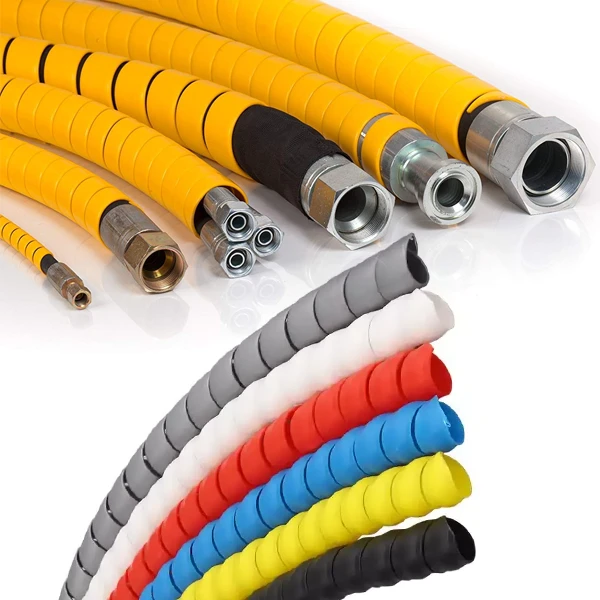
A hose dragged 50 times per shift across concrete is exposed to a different wear pattern than a fixed hose mounted overhead. Cover thickness, rubber compound, and hose protection such as sleeves or guards become more relevant when abrasion is concentrated near couplings, machine edges, or floor contact points.
Abrasion controls should not create sharp bend points. Most manufacturers specify a minimum bend radius, and repeatedly forcing the hose below that radius can concentrate stress in the reinforcement; a hose bent too tightly near a crimped fitting may fail earlier even when pressure remains 20% below its rated maximum.
Length also affects handling. A 50 m hose may be convenient for coverage but adds friction loss, weight, and more surface area for abrasion, while two shorter sections introduce another coupling pair and additional internal restriction. Fixed installations often work better with rigid distribution piping feeding shorter flexible drops.
For air lines with oil-lubricated compressors, tube compatibility deserves separate attention. Compressor carryover may be small in a maintained system, but repeated exposure over months or years can soften or swell compounds that were intended mainly for water and clean air.
NBR-lined multipurpose hose is often selected for this environment. If water remains the dominant medium and oil exposure is rare, EPDM may still be preferred, but the technical data sheet should state compatibility rather than relying on the general label “air/water.”
Chemical additives complicate water service in the same way. Cooling-water treatments, detergents, glycol mixtures, disinfectants, and cleaning agents can behave differently from plain water; even a solution containing 10% or 20% of another chemical should be checked against the tube compound before purchase.
Temperature deserves equal attention in washdown work. Ambient water at 20°C and hot water at 90°C should not be treated as one application, because elevated temperature can reduce allowable working pressure and accelerate rubber aging.
Steam requires a separate hose specification. A water hose rated to 100°C should not automatically be used for steam because saturated steam at pressure carries far more thermal energy, and dedicated steam hoses use compounds, reinforcement, couplings, and operating procedures designed for that service.
Assembly quality can be as important as hose construction. A hose rated at 20 bar connected to a fitting rated at 10 bar should be treated as a 10 bar assembly, and a coupling that does not match the hose OD, wall thickness, or reinforcement can pull out before the hose body fails.
-
Check working pressure at the actual operating temperature.
-
Confirm air, water, oil, or additive compatibility with the inner tube.
-
Match hose ID to required flow and total run length.
-
Use a suction-rated construction on pump inlets.
-
Match coupling pressure rating to or above the hose rating.
-
Inspect abrasion zones, bends, crimps, and coupling security regularly.
-
Replace assemblies showing reinforcement exposure, blistering, deep cuts, coupling movement, or abnormal swelling.
Inspection frequency should reflect usage rather than a fixed calendar rule. A hose used 8 hours per day on a fabrication floor needs more frequent inspection than a backup hose used once per month, and any inspection program should follow the hose and coupling manufacturer’s guidance.
Age is also not a complete measure of remaining service life. A hose installed in 2024 but exposed continuously to heat, oil, sunlight, tight bending, and abrasion may deteriorate faster than an older hose stored correctly and used intermittently.
Purchasing specifications work better when they contain measurable requirements. “Multipurpose air and water hose” is too broad; a useful specification could state 19 mm ID, 20 bar minimum working pressure at the intended temperature, EPDM or NBR tube according to media, textile reinforcement, weather-resistant cover, and compatible crimped fittings.
For a plant using 7–10 bar compressed air and ordinary industrial water, reinforced multipurpose rubber hose usually offers the best balance between flexibility, pressure capability, durability, and handling. EPDM suits water and outdoor exposure well, NBR is preferable where oil contact is regular, PVC fits lighter-duty work, and polyurethane is commonly used for smaller pneumatic lines.
Selection should remain tied to published manufacturer data. Pressure, temperature, fluid compatibility, vacuum rating, minimum bend radius, electrical properties where relevant, fitting retention, and applicable ISO, EN, SAE, or workplace requirements provide more useful information than hose color, wall thickness, or price alone.